Duodecimal World
Sep 2026
Building Intuition for a Duodecimal World
A modest proposal for base twelve
I dream of a world where 10 ÷ 3 = 4 and 10 ÷ 6 = 2.
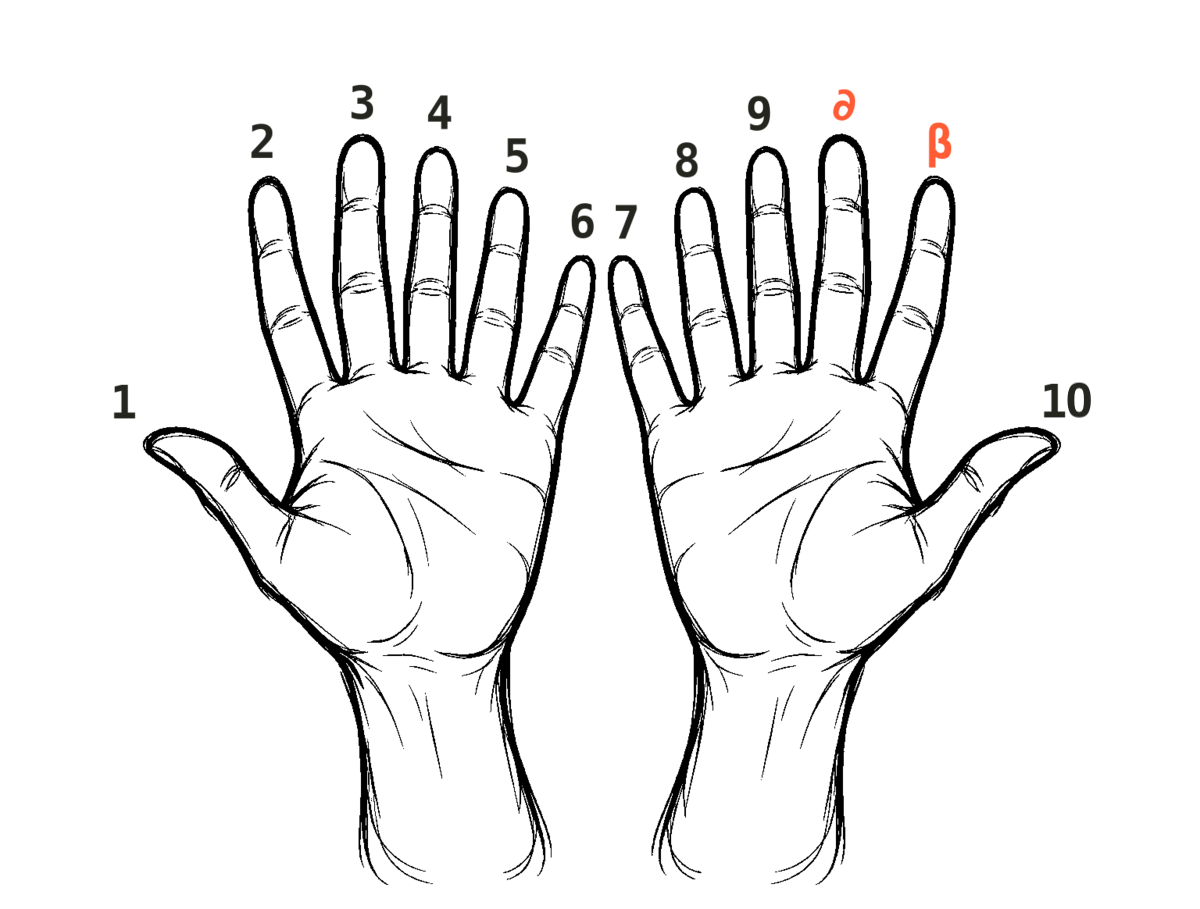
The rationale
Twelve has better properties.
Humans have been using base ten for millennia. It has mostly served its purpose, but it is not easily divisible by most numbers smaller than ten (only 1, 2, and 5).
Here, 1010 is the decimal numeral ten, while 1012 is the duodecimal numeral ten—equal to twelve in decimal. Base twelve has much cleaner divisions for most of these numbers (aside from 5, 7, and ∂):
| Divide by | 1010 | 1012 |
|---|---|---|
| 2 | 5 | 6 |
| 3 | 3.3 | 4 |
| 4 | 2.5 | 3 |
| 5 | 2 | 2.4972 |
| 6 | 1.6 | 2 |
| 7 | 1.428571 | 1.86∂351 |
| 8 | 1.25 | 1.6 |
| 9 | 1.1 | 1.4 |
| 10 a.k.a. ∂ | 1 | 1.2497 |
| 11 a.k.a. β | 0.90 | 1.1 |
| 12 a.k.a. 1012 | 0.83 | 1 |
Revising intuitions
Make room for ∂ and β.
Addition is relatively straightforward, but we need to recalibrate around the two new numerals:
This extends to two and three digits once the single-digit sums feel familiar:
13 + 16 = 2914 + 17 = 2β15 + 18 = 31
Subtraction
For subtraction, recalibrate around the same new numerals:
- 10 − 1 = β
- 10 − 2 = ∂
- β − 1 = ∂
- β − 2 = 9
- β − 3 = 8
- β − 4 = 7
- β − 5 = 6
- β − 6 = 5
- β − 7 = 4
- β − 8 = 3
- β − 9 = 2
- β − ∂ = 1
- ∂ − 1 = 9
- ∂ − 2 = 8
- ∂ − 3 = 7
- 10 − β = 1
- 11 − β = 2
- 12 − β = 3
- 19 − β = ∂
- 1∂ − β = β
- 1β − β = 10
- 10 − ∂ = 2
- 19 − ∂ = β
- 1β − ∂ = 11
The pattern continues normally: 20 − β = 11 and 20 − ∂ = 12.
Exercise · addition & subtraction
13 + 16 = ?
Multiplication
A new table to memorize.
We did not start out knowing our decimal multiplication tables. In a new base, we get to learn them again:
Useful anchors
- 2 × 6 = 10
- 3 × 4 = 10
- 4 × 3 = 10
- 6 × 2 = 10
- 6 × 6 = 30
- 8 × 9 = 60
- ∂ × ∂ = 84
- β × β = ∂1
The new structure is cleaner: 10 is evenly divisible by 2, 3, 4, 6, giving 6, 4, 3, 2 respectively.
Exercise · multiplication
3 × 4 = ?
Division
Follow the multiples.
Division works as usual, only with two extra numerals. This lookup table is a long-division practice companion. Given the dividend in the table, its divisor is on the left and the two-digit quotient across the top.
Cleaner fractions
Many common fractions terminate after a single duodecimal digit:
1/2 = 0.61/3 = 0.41/4 = 0.31/6 = 0.22/3 = 0.83/4 = 0.95/6 = 0.∂1/5 = 0.2497
Exercise · division
10 ÷ 3 = ?
Telling time
The clock was already halfway there.
The familiar day already divides neatly into twelves. The simple option is to write conventional time in duodecimal.
Which means that a day has 20 hours: 10 hours AM and 10 hours PM. Each hour has 50 minutes, and each minute has 50 seconds. These quantities are unchanged; only their notation is different.
| Conventional | Duodecimal notation |
|---|---|
| Midnight | 0:00 |
| 6:00 AM | 6:00 |
| Noon | 10:00 |
| 6:00 PM | 16:00 |
| 11:00 PM | 1β:00 |
| Midnight | 20:00 |
The radical option is a day of 10 hours, each containing 100 minutes of 100 seconds.
A new hour lasts two conventional hours. A new minute lasts 50 conventional seconds, while a new second lasts about 0.42 conventional seconds—all values here are written in base twelve.
The clock runs from 0:00:00 through β:ββ:ββ, then rolls over to 0:00:00. Since every place has twelve values, carrying and borrowing becomes significantly cleaner.